GAMERS, ANTI-WOKE IDENTITY POLITICS AND ILLITERATE CONSERVATISM GAMERS, O IDENTITARISMO ANTI-WOKE E O CONSERVADORISMO ILETRADO
-Date: 2024-12-19 · Games · Culture · Politics Games · Cultura · Política
ENTRY DATADADOS DA ENTRADA
◀ Back to Blog◀ Voltar
ENTRY DATADADOS DA ENTRADA
DateData 2024-12-19
Tags Games · Culture · Politics Games · Cultura · Política
Status PublishedPublicado

The Witcher 4 trailer revealed more than the return of an acclaimed franchise: it also revealed a new, fiercely identitarian audience that is beginning to organize.

During the Game Awards 2024 ceremony, the long-awaited cinematic trailer for The Witcher 4 was finally revealed. After the resounding success of The Witcher 3: Wild Hunt in 2015, both in sales and in reviews, it was only a matter of time before CD Projekt Red announced a sequel. It took nine years, but the confirmation finally came. And with it, a significant change: Geralt, the protagonist of the first three games, will apparently give way to his adoptive daughter, Ciri, as the main character.

But more than the speculation about new combat mechanics or the direction of the story, what drew attention was the reaction of a specific group of gamers to Ciri's leading role. This is a segment that calls itself anti-woke, rejecting any progressive element in works of pop culture — something I will call here illiterate conservatism.

The Witcher 4 — cinematic trailer, The Game Awards 2024.

Illiterate Conservatism

Illiterate conservatism is not merely a critical stance or an occasional rejection of progressive themes. It is a dogmatic identity politics in which acceptance or rejection of a work depends solely on its adherence to a rigid set of conservative values. If anything considered woke is found in a work, it is rejected outright.

One telling expression of this is a Steam community group called Woke Game Detector. With more than 2,000 members and over 6,000 followers, the group's purpose is to rate games according to the level of woke content found in them, classified on the following scale:

"Recommended" = no woke themes found. "Informational" = woke themes present, but with no specific or subtle message. "Not Recommended" = woke themes present with a message.

Working from this scale, followers and members would know in advance which games to buy, avoiding exposure to a kind of content that runs against the dogmas set out by the identity they have assumed. According to the group's description, woke content includes: "pro-LGBTQ+, pro-DEI (Diversity, Equity and Inclusion), pro-climate action, pro-communism/socialism, pro-abortion, pro-pedophilia, pro-immigration, pro-transhumanism, anti-Western society, anti-humanity, anti-colonialism, anti-capitalism, anti-heterosexuality, anti-patriarchy, anti-white, anti-family, anti-free speech, anti-guns, etc." All of this, through the lens of such a group, is seen as a threat to the integrity of gamer culture.

Mods as Purification

Even so, some games appear to be attractive enough to cut across that identity politics. But for that, the anti-woke gamer community has a solution: mods, or community-made modifications that alter or remove "undesirable" aspects of games. On the ModHQ site, for instance, it is possible to download modifications that remove LGBTQIA+ characters, alter and/or remove dialogue considered progressive, change the appearance of Black NPCs to white, or even alter in-game statues into the pose of the Nazi salute. Two of these mods in particular revisit minor events in The Witcher 3: one eliminates a dialogue in which a male character mentions his romance with another man; the other alters the quest where a male NPC is found dressed as a woman, suggesting he would be a drag queen. Although the game was released in 2015, these mods were created only in 2024, which draws attention to the recent emergence of this anti-woke identity politics in a more organized form.
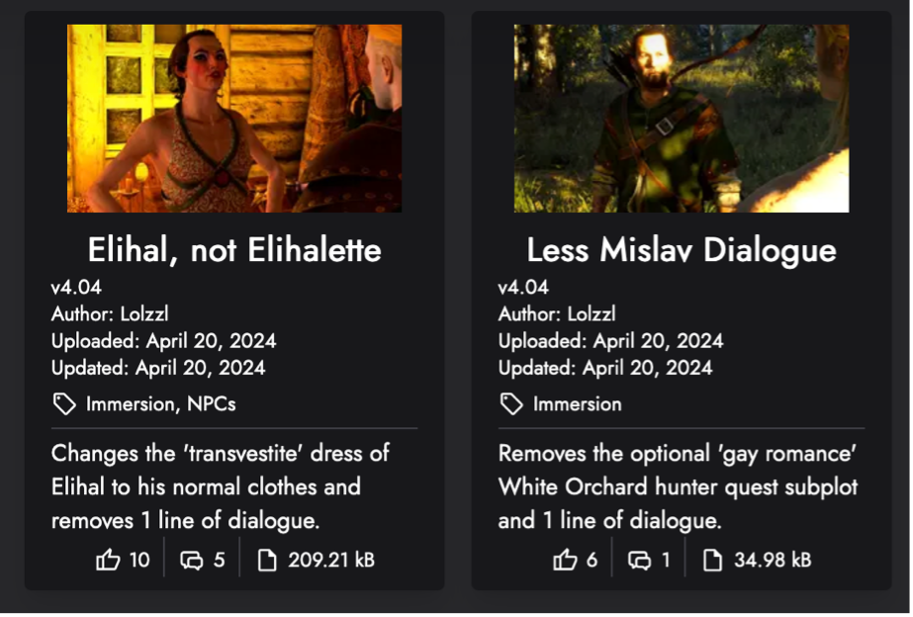
Two mod listings on ModHQ: 'Elihal, not Elihalette', which changes a character's dress back to his normal clothes and removes a line of dialogue, and 'Less Mislav Dialogue', which removes an optional gay romance subplot and one line of dialogue.
Source: ModHQ

The Witcher 4 and the Failure to Read

And how does this connect to The Witcher 4 trailer? Well, Ciri's leading role — a woman character — in the six-minute cinematic was enough to draw the fury of these anti-woke gamers. And with that, we can get to illiterate conservatism.

Anyone who has played the previous games — or at least the third one in particular — would already have known in advance that this change was coming. Ultimately, the narrative told across the last game is precisely a passing of the torch from Geralt to Ciri. The most critical moments for the narrative, which depend on the player's choices to reach its "correct" ending, involve Geralt taking up his role as a father who gives way to Ciri rather than taking the lead in her place, trusting her abilities and making room for her to become an adult woman and a formidable warrior. Beyond that, over the course of the game we get to play as Ciri for brief stretches and see how extremely powerful she is, leaving behind a feeling of "I want more" and the anticipation of what is to come in the next title.

Finally, the themes the game takes up, especially in its side quests, are very much what would be classified today as "woke" — but they either went unnoticed or were not considered a problem in 2015 by these same gamers. In many of the game's quests, Geralt is hired to kill monsters supposedly causing some harm, but in the end the player discovers they are nothing more than people who have been discriminated against and/or brutalized, usually on the basis of deep-rooted beliefs and prejudices. In other cases, the monsters and curses Geralt must resolve are the result of humanity's own villainy: in exercising their prejudices, people create the very evil that later returns to haunt them. Not to mention the witch hunt, which emulates its historical version with very little subtlety. As Geralt himself says in the game: "hatred and prejudice will never be eradicated, and witch hunts will never be about witches. To have a scapegoat — that's the key."

"Hatred and prejudice will never be eradicated…" — The Witcher 3: Wild Hunt.

Even though it rests on allegories of monsters and magic, the game's message is quite clear. But there is no clarity that illiterate conservatism cannot obscure with its incapacity for textual interpretation. And so the leading role of a female character was met by this anti-woke audience with the same torches and pitchforks the villagers of the previous game carried — the very ones Geralt stood against.

Fans, or Opportunists?

Conservative militancy has formed identity groups with a force equal to or greater than that of the progressive identity politics of years past. Now organized in online groups, anti-woke gamers put in a great deal of work to filter or even modify works that do not align with the values they identify with. Mixed with illiterate conservatism, even franchises built out of progressive ideas end up becoming targets of such movements. And the question that remains is: are they really fans of franchises like The Witcher? Or are they merely instrumentalizing these games as a platform to express their prejudices?

I dare believe we are talking about people who have never played these games, and that we are dealing with opportunists who never took an interest in the franchise until they found in the recent trailer a chance to carry out their misogynistic militancy. At the same time as these "critiques" became visible across social networks, a countermovement could also be found. Memes in various formats resignify figures like "chads" and "betas" by inverting their positions: misogynistic betas shamefully reject the Witcher 4 trailer for having a female protagonist and therefore being woke, while a chad version of Geralt stands in for the authentic fan of the franchise, who happily welcomes the reveal and hopes the card game Gwent returns in the new title.

We are left to see how productions in the games industry will react to this phenomenon. It also remains an open question whether this group is genuinely large and capable of affecting sales — especially given the emergence of mods catering to this conservative identity — or whether it is another case of a minority that simply shouts louder.

And, finally, the doubt that lingers: how do you engage an audience that, out of identitarian fundamentalism, refuses works before even encountering them?

// Note: This is a translated version of the original Portuguese text. The author will review and revise this translation.

Trailer de The Witcher 4 não revela apenas a volta de uma franquia aclamada, mas também um novo público ferrenhamente identitário e que começa a se organizar.

Durante a cerimônia do Game Awards 2024, o aguardado trailer cinemático de The Witcher 4 foi revelado. Após o sucesso estrondoso de The Witcher 3: Wild Hunt em 2015, tanto em vendas quanto em críticas, era apenas questão de tempo para que a CD Projekt Red anunciasse uma sequência. Demoraram nove anos, mas finalmente a confirmação chegou. E com ela, uma mudança significativa: Geralt, protagonista dos três jogos, aparentemente dará lugar a sua filha adotiva, Ciri, como personagem principal.

Porém, mais do que as especulações sobre novas mecânicas de combate ou o direcionamento da história, o que chamou a atenção foi a reação de um grupo específico de gamers ao protagonismo de Ciri. Trata-se de uma parcela que se autodenomina anti-woke, rejeitando qualquer elemento progressista em obras da cultura pop – algo que aqui chamarei de conservadorismo iletrado.

The Witcher 4 — trailer cinemático, The Game Awards 2024.

O Conservadorismo Iletrado

O conservadorismo iletrado não é apenas uma postura crítica ou uma rejeição pontual a temas progressistas. Trata-se de um identitarismo dogmático, onde a aceitação ou rejeição de uma obra depende unicamente de sua adesão a um conjunto rígido de valores conservadores. Se numa obra algo considerado woke é encontrado, ela é rejeitada de cara.

Uma expressão ilustrativa é um grupo de comunidade na Steam intitulado Woke Game Detector. Com mais de 2 mil membros e mais de 6 mil seguidores, o objetivo do grupo é avaliar jogos em relação ao nível de conteúdo woke encontrado, que são classificados na seguinte escala:

"Recomendado" = sem temas woke encontrados. "Informacional" = temas woke presentes, mas sem mensagem específica ou sutil. "Não Recomendado" = temas woke presentes com mensagem.

A partir desta escala, seguidores e membros estariam informados sobre quais jogos comprar de antemão, evitando serem expostos a um tipo de conteúdo que vai contra os dogmas delimitados pela identidade assumida. De acordo com a descrição do grupo, conteúdos woke incluem: "mensagens pró-LGBTQ+, pró-DEI (Diversidade, Equidade e Inclusão), pró-ação climática, pró-comunismo/socialismo, pró-aborto, pró-pedofilia, pró-imigração, pró-transumanismo, antissociedade ocidental, anti-humanidade, anticolonialismo, anticapitalismo, anti-heterossexualidade, antipatriarcado, antibrancos, antifamília, antiliberdade de expressão, antiarmas etc" (tradução livre). Tudo isso, sob a lente de tal grupo, é visto como uma ameaça à integridade da cultura gamer.

Os Mods como Purificação

Ainda assim, alguns jogos parecem ser tão atrativos que atravessam tal identitarismo. Mas para isso, a comunidade de gamers anti-woke tem solução: mods, ou modificações criadas pela comunidade, que alteram ou removem aspectos "indesejados" dos jogos. No site ModHQ, por exemplo, é possível baixar modificações que removem personagens LGBTQIA+, alteram e/ou removem diálogos considerados progressistas, transformam a aparência de NPCs negros para brancos, ou mesmo alteram estátuas dentro do jogo para a pose da saudação nazista. Dois desses mods, em particular, revisitam eventos menores de The Witcher 3: um elimina um diálogo onde um personagem masculino menciona seu romance com outro homem; outro altera a missão onde um NPC masculino é encontrado vestido de mulher, sugerindo que seria uma drag queen. Apesar do jogo ter sido lançado em 2015, tais mods foram criados apenas em 2024, o que chama atenção para o surgimento recente desse identitarismo anti-woke de forma mais organizada.

Dois mods listados no ModHQ: 'Elihal, not Elihalette', que troca o vestido de um personagem por suas roupas normais e remove uma linha de diálogo, e 'Less Mislav Dialogue', que remove um subenredo opcional de romance gay e uma linha de diálogo.
Fonte: ModHQ

Witcher 4 e a Incapacidade de Interpretar

E como isso se conecta com o trailer de The Witcher 4? Bom, o protagonismo de Ciri, uma personagem mulher, no cinemático de 6 minutos, foi suficiente para atrair a fúria desses gamers anti-woke. E, com isso, podemos tocar no conservadorismo iletrado.

Qualquer um que tenha jogado os jogos anteriores – ou ao menos o terceiro em especial – já saberia de antemão que tal mudança estava por vir. Em última instância, a narrativa contada ao longo do último jogo é exatamente uma passagem de tocha de Geralt para Ciri. Os momentos mais críticos para a narrativa, que depende de escolhas do jogador para chegar em seu final "correto", envolvem Geralt assumir seu papel como pai que dá a vez a Ciri em vez de assumir o protagonismo em seu lugar, confiando nas suas habilidades e dando espaço pra que ela se torne uma mulher adulta e uma guerreira formidável. Além disso, ao longo do jogo podemos jogar com Ciri por alguns instantes e ver como ela é extremamente forte, deixando um sentimento de "quero mais" e a expectativa do que virá no próximo título.

Finalmente, os temas abordados, em especial em missões secundárias do jogo, são muito do que seria classificado hoje como "woke", mas ou passou despercebido ou não foi considerado um problema em 2015 por estes mesmos gamers. Em muitas missões do jogo, Geralt é contratado para matar monstros que estariam causando algum mal, mas que, no final, o jogador descobre não ser nada além de pessoas discriminadas e/ou violentadas, geralmente a partir de crenças enraizadas e preconceitos. Em outros casos, os monstros e maldições que Geralt precisa resolver são resultado da vilania da própria humanidade, que, ao exercer seus preconceitos, cria o próprio mal que depois volta para assombrá-la. Sem falar na caça às bruxas, que emula com pouca sutileza sua versão histórica. Por fim, como diz o próprio Geralt no jogo: "ódio e preconceito nunca serão erradicados, e a caça às bruxas nunca foi sobre bruxas. Ter um bode expiatório, essa é a chave."

"Ódio e preconceito nunca serão erradicados…" — The Witcher 3: Wild Hunt.

Ainda que se sustente em alegorias com monstros e magia, a mensagem do jogo é bem clara. Mas não há clareza que o conservadorismo iletrado não seja capaz de obscurecer com sua incapacidade de interpretação textual. Assim, o protagonismo de uma personagem feminina foi recebido por esse público anti-woke com as mesmas tochas e forquilhas que os vilões do jogo anterior empunhavam – e aos quais Geralt se opunha.

Fãs ou Aproveitadores?

A militância conservadora formou grupos identitários com uma força igual ou maior aos do identitarismo progressista de anos atrás. Agora organizados em grupos online, gamers anti-woke exercem um grande trabalho para filtrar ou até mesmo modificar obras que não se alinham aos valores aos quais se identificam. Misturado ao conservadorismo iletrado, mesmo franquias que se formaram a partir de ideários progressistas acabam virando alvo de tais movimentos. E a questão que fica é: eles são realmente fãs de franquias como The Witcher? Ou estão apenas instrumentalizando esses jogos como uma plataforma para expressar seus preconceitos?

Ouso acreditar que estamos falando de pessoas que nunca jogaram tais jogos, e que estamos falando de aproveitadores que nunca se interessaram na franquia até acharem no trailer recente uma oportunidade de realizar sua militância misógina. Ao mesmo tempo em que tais "críticas" se evidenciaram nas redes, um movimento contrário também pode ser encontrado. Memes em diversos formatos ressignificam figuras como "chads" e "betas", invertendo suas posições: betas misóginos rejeitam vergonhosamente o trailer de Witcher 4 por ter uma protagonista mulher e, portanto, ser woke, enquanto uma versão chad de Geralt representa o fã autêntico da franquia, que aprecia alegremente a revelação e torce para que o jogo de cartas Gwent retorne no novo título.

Ficamos a ver qual será a reação das produções na indústria dos games a esse fenômeno. Também é uma incógnita se esse grupo é realmente grande e tem capacidade de impactar nas vendas – ainda mais considerando o surgimento de mods que atendem a essa identidade conservadora – ou se é mais um caso de uma minoria que grita mais alto.

E, por fim, a dúvida que fica: como dialogar com um público que, por fundamentalismo identitário, recusa obras de antemão?